

In today’s digital world, every business—big or small—must rely on Content Marketing to attract customers, build trust, and grow online visibility. But simply creating content is not enough. You need a winning Content Marketing strategy that helps you reach the right audience, publish valuable content, and achieve measurable business results.
This guide explains how to create a powerful Content Marketing strategy step-by-step, even if you are a beginner.
What Is Content Marketing?
Before building a strategy, you must understand what Content Marketing really means.
Content Marketing is a long-term marketing approach focused on creating, publishing, and distributing valuable content to attract, engage, and convert your target audience.
Content Marketing includes:
- Blogs
- Videos
- Social media posts
- Infographics
- Email newsletters
- Podcasts
- Ebooks & guides
- Case studies
The primary goal of Content Marketing is not just promotion—it is building trust and providing value. When businesses use Content Marketing consistently, they experience long-term growth.
Why You Need a Strong Content Marketing Strategy
A winning Content Marketing strategy helps you:
1. Reach the Right Audience
It ensures your content is aimed at people who are most likely to buy from you.
2. Improve SEO and Search Rankings
Content Marketing improves organic traffic and increases your visibility on Google.
3. Build Trust and Authority
High-quality content positions your brand as an expert.
4. Increase Conversions
Content Marketing guides your audience from awareness to purchase.
5. Reduce Paid Advertising Costs
When your content performs well, you depend less on paid ads.
A clear Content Marketing strategy gives direction, goals, and consistency.
Table of Contents
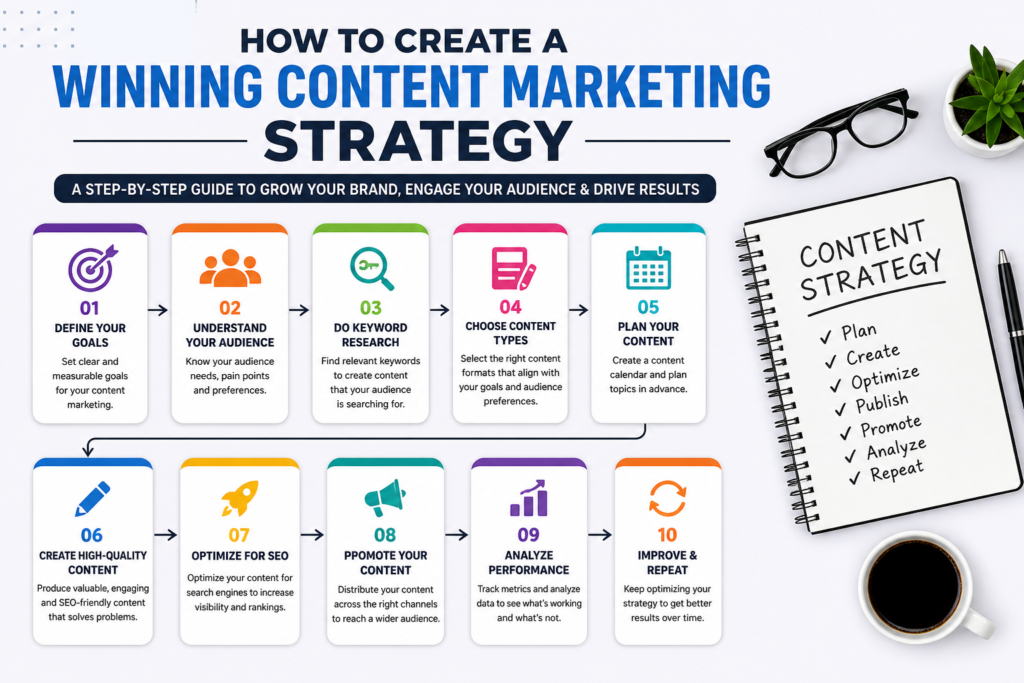
Step-by-Step Guide to Create a Winning Content Marketing Strategy
Below is a detailed, actionable process to create a Content Marketing strategy that actually works.
Step 1: Define Your Goals
Every Content Marketing plan must start with clear goals. Ask yourself:
- Do you want more website traffic?
- Do you want to increase leads?
- Do you want to boost brand awareness?
- Do you want to get more sales?
Example goals for Content Marketing:
- Get 30% more website traffic in 3 months
- Generate 100 new leads every month
- Increase email subscribers by 500
- Improve Google ranking for target keywords
When your goals are clear, your Content Marketing strategy becomes more focused.
Step 2: Understand Your Target Audience
Effective Content Marketing must speak directly to the needs of your audience.
Create a buyer persona, which includes:
- Age
- Gender
- Location
- Interests
- Pain points
- Goals
- Online behavior
- Buying habits
For example:
Buyer Persona Example:
Ravi, 28, startup owner, needs digital marketing knowledge, searches Google for marketing tips, watches YouTube tutorials, prefers step-by-step guides.
When you understand your audience deeply, your Content Marketing becomes powerful and relatable.
Understanding your target audience is the most important foundation of successful Content Marketing. Before you create any content, you must know who your ideal customer is, what problems they face, and what solutions they are searching for. This helps you create content that feels relevant, valuable, and personalized.
Start by identifying basic details such as age, gender, location, and profession. Then go deeper—understand their interests, challenges, goals, and online behavior. Analyze what type of content they consume: blogs, videos, reels, or email newsletters. Study their frequently asked questions and common pain points.
Use tools like surveys, social media insights, Google Analytics, and customer feedback to learn more about your audience. When your audience feels that your content speaks directly to them, your Content Marketing becomes more powerful, engaging, and effective. Knowing your audience ensures higher trust, stronger relationships, and better conversions
Step 3: Conduct Keyword Research
Keyword research is the backbone of Content Marketing. It helps you understand what people are searching for.
Use tools like:
- Google Keyword Planner
- Ahrefs
- SEMrush
- Ubersuggest
- AnswerThePublic
Find keywords with:
- High search volume
- Low to medium competition
- High user intent
Include your focus keyword “Content Marketing” naturally throughout your article. Keyword research guides your blog topics, video ideas, and social media content.
Step 4: Choose the Right Content Types
Not all types of content work for every business. Select the formats that match your audience.
Popular Content Marketing Formats:
- Blog articles
- YouTube videos
- Instagram reels
- LinkedIn posts
- Infographics
- Case studies
- Email newsletters
- Webinars
- Ebooks
- Short-form educational videos
Choose the 3–5 content types that best support your goals.
Step 5: Plan Your Content Calendar
Consistency is the secret of successful Content Marketing.
A content calendar helps you plan:
- What to publish
- When to publish
- Where to publish
- Who will create it
Your content schedule can be:
- Daily (social media posts)
- Weekly (blog posts)
- Monthly (guides, videos, newsletters)
A structured calendar makes your Content Marketing process organized and efficient.
Step 6: Create High-Quality Content
Your content must be:
- Valuable
- Informative
- Helpful
- Easy to understand
- SEO-optimized
- Engaging
Tips to Create Great Content:
1. Start With Strong Headlines
A compelling title can increase clicks by 50%.
2. Use Simple Language
Users prefer clear and easy-to-read content.
3. Add Visuals
Images, charts, and infographics improve engagement.
4. Focus on SEO
Include your keyword Content Marketing naturally.
5. Use Real Examples
Examples make content more practical.
High-quality content is the heart of Content Marketing success.
Step 7: Optimize Your Content for SEO
SEO determines whether your Content Marketing reaches your audience or disappears online.
On-page SEO checklist:
- Use your primary keyword Content Marketing in the title
- Use it in the first paragraph
- Add it in subheadings
- Include it 1–2% throughout the content
- Add semantic keywords (related keywords)
- Use 150–160 character meta descriptions
- Optimize images with alt text
- Use internal and external links
- Increase readability
SEO ensures that your Content Marketing generates long-term organic traffic.
Step 8: Publish and Promote Your Content
Publishing is only half the job. Successful Content Marketing requires strong promotion.
Promotion Channels:
- YouTube
- Email newsletters
- WhatsApp broadcast
- Quora
- Guest posting
- Backlink outreach
Without promotion, even the best Content Marketing goes unnoticed.
Step 9: Track and Measure Performance
The only way to improve your Content Marketing is by measuring results.
Use tools like:
- Google Analytics
- Google Search Console
- Ahrefs
- HubSpot
- SEMrush
Track KPIs such as:
- Website traffic
- Keyword rankings
- Engagement rate
- Click-through rate (CTR)
- Leads generated
- Sales conversions
A winning Content Marketing strategy is data-driven.
Tracking and measuring performance is a crucial part of any successful Content Marketing strategy. Without analyzing your results, you won’t know what is working, what needs improvement, or where to invest more effort. Performance tracking helps you understand how your audience interacts with your content and whether your strategy is moving you toward your goals.
Start by identifying clear KPIs (Key Performance Indicators). Common KPIs in Content Marketing include website traffic, time spent on page, bounce rate, keyword rankings, click-through rate, social media engagement, lead generation, and conversions. These metrics show how effectively your content attracts and engages your audience.
Use tools like Google Analytics to monitor traffic, Google Search Console to track keyword performance, and social media insights to understand engagement. Email marketing platforms also provide open rates and click rates, helping you measure the effectiveness of newsletters.
Regularly reviewing these metrics allows you to optimize your Content Marketing approach. You can identify top-performing content, update underperforming pages, and refine your topics based on user behavior. Tracking performance ensures your strategy stays data-driven, focused, and continuously improving.

Step 10: Optimize and Improve Continuously
Content Marketing is not a one-time activity. It requires regular updates and improvements.
Optimization is an ongoing process and one of the most important pillars of successful Content Marketing. Creating content once is not enough—your content must remain fresh, relevant, and aligned with user intent. As search trends, audience behavior, and platforms evolve, your content must evolve too. Continuous improvement ensures that your Content Marketing efforts keep delivering results over time.
Start by regularly updating your existing content. Review older blog posts, videos, or Content Marketing them with new statistics, updated examples, better visuals, and improved explanations. Google rewards updated content, which means your pages can achieve better rankings and higher visibility. Updating content also improves user experience, making it easier for your audience to trust your expertise.
Next, analyze what type of content performs best. Look at high-performing pages and identify what makes them successful—strong keywords, engaging structure, high-quality visuals, or clear call-to-actions. Apply these insights to your future Content Marketing efforts. Similarly, examine underperforming content. Improve headlines, rewrite sections, add new keywords, or include more value
How to optimize your strategy:
- Update old blog posts
- Add new keywords
- Improve headlines
- Add videos inside articles
- Refresh images
- Rewrite outdated sections
- Repurpose old content into new formats
When you consistently optimize your Content Marketing, your results grow steadily.
Bonus Tips for a Successful Content Marketing Strategy
Here are some expert-level tips to improve your Content Marketing instantly:
✔ Make your content 90% valuable and 10% promotional
Don’t oversell. People trust brands that educate.
✔ Use storytelling
Stories make your content more memorable.
✔ Focus on user intent
Give people exactly what they are searching for.
✔ Repurpose your content
Convert one blog into a video, social post, infographic, and email.
✔ Stay updated with industry trends
Content Marketing evolves every year.
Conclusion
Creating a powerful Content Marketing strategy is not a one-time task but an ongoing journey. Understanding your target audience, tracking performance, and continuously optimizing your content are the key elements that keep your strategy effective and relevant. When you know what your audience needs, you can create high-value content that builds trust and drives engagement. By measuring results, you can identify what’s working and refine your approach with confidence. And through continuous improvement—updating old content, repurposing top-performing pieces, and enhancing your SEO—you ensure long-term success. In a competitive digital world, brands that invest in smart, consistent Content Marketing always stay ahead. If you follow these principles, your content will not only attract more traffic but also convert your audience into loyal customers.